Sunday, September 25, 2011

Happy Hour: Wine Edition


I think that the worst part about being under 21 is that you don't know about, can't enjoy, and aren't invited to happy hour. I think it just might be the holy grail of the twenties. I've certainly spent enough time pursuing half-off appetizers and dirt cheap well drinks, that it could be some sort of religious calling for me. 

Not only have they occupied many a weeknight, happy hours have ruined the full-price dinner for me completely. I find it increasingly difficult to eat at regular restaurants (why are these fries $7 and not $3.50? why are these sliders $3 a piece instead of $1?). And bar drinks are a similar story. It's just not worth it to go out to drink when a mojito costs $9-11 dollars and contains somewhere between half a shot and one ounce of rum. It's even harder when you order a glass of wine, at $8-$12 a glass, you might as well go buy the bottle of wine for $7.99 at a Safeway down the street and drink it in the parking lot. It'd probably save time and money. Wine is the last thing I would order out at a bar and it also seems to be the one thing Happy Hour still can't knock down to a reasonable price. 

I was reading an article in the Wall Street Journal about demystifying the exorbitant mark-ups of wine in restaurants and I feel a bit more clued in about the insane mark-up for glasses of wine. Bottles are another story. The article reasoned that, based on a host of restaurants around New York, that the average restaurant marks up their bottles of wine 300%. Read: a jug of Yellow Tail Chardonnay would be $24 in a restaurant. Yellow Tail aside, it makes great, affordable wines, completely ridiculous to purchase ($30+ for a Chateau Ste. Michelle Pinot Gris? Not tonight). And that's just the bottle price. That same Yellow Tail Chardonnay, in a glass instead of a bottle, would cost $6-$7... or, the exact price of a jug of that wine in grocery stores. 

It upsets me to say this, but this price insanity is actually driven by logic. When a customer orders that glass of Yellow Tail Chardonnay, the bottle must be opened and a small amount of the wine poured out. Once opened, the wine's shelf life drops rapidly (two to three days, at the most). If no one else walks into that restaurant and also orders a glass of that white wine, then the bottle is ruined and the restaurant will immediately face a loss. Hence the mark-up. That one glass had better at least help the restauranteer break even...

With this all being said, I was skeptical when a colleague at work suggested a place that had half-off bottles of wine on Tuesday and Thursday nights. Without a wine list and wine prices published online (this helps restaurants protect themselves from snooping customers looking to determine which wines are marked up the most, as well as snooping competitors gauging how much they can sell their wine for), and never having ordered a bottle of wine at a restaurant, I decided to try it out. When I arrived there for a late-night happy hour with friends, the place (Maxwell's) looked closed, but pushing open the door, we were greeted by an intimate restaurant with a glittering chandelier and a crackling fire. The bar was small and though it wasn't crowded, almost everyone had a bottle of wine at their table and a whole host of the appetizers that were also half-off. The wine list was large and exciting. Most of the bottles were ones I hadn't heard of and hadn't seen in store. Even better... they had bottles of wine under $30. And at the happy hour special, those wines were half-off. Such a major discount actually brought the marked-up wines down to a reasonable price, normally a dollar or two over the price in stores.

I ordered a 2010 Leyda Pinot Noir Classic from Chile ($13.99 retail, $15 with the happy hour discount at Maxwells). The wine was absolutely beautiful in color, a sparkling bright burgundy that was so clear that you could see the light reflecting in and out of the glass. It was very full of berry notes for a Pinot Noir, but it maintained the softness and lightness of some of the great Willamette Valley Pinot Noirs. The bouquet was sweet and reminded me of a Riesling or a sweeter white wine. The front notes were of berries, notably blackberries and strawberry and the sweetness developed into a smooth and minerally finish, with a hint of spice. The wine lingered, but only delicately, and it showed no heaviness or jammy-ness of some of the other less expensive Pinot Noirs I've tried. I would definitely recommend this wine and the restaurant (and I suppose the entire notion of happy hour) for both beating my expectations and god-awful wine list mark-ups.

Sunday, September 18, 2011

Summer's Last Stand

This week marked the last week of summer here in Washington. Though the past few weeks of sun and above-70 degree temperatures seemed out of the ordinary, it's hard to welcome the 50-60 degree misting and grey skies that mark the onslaught of Washington's fallwinterspring season. The bright side is pumpkin flavored treats, a rekindled interest in drinking tea, and the chunky sweaters that can be brought out of storage and worn again.


Inspired by foodgawker.com's end-of-summer everything-peaches recipes and our local gourmet grocery store's Peach-O-Rama month, I planned on making a peach and brie quesadilla with peach salsa and drinking a Pinot Grigio/Gris as a pairing. Unfortunately, I decided to have a lemon drop (or two) between dicing up peaches and ended up forgetting about the Pinot Gris I'd bought entirely. Tipsy and covered in melted brie, I ended up saving the wine for a time when my palate wasn't completely destroyed by Absolut Citron and sugared martini glass rims. The peach quesadillas were delicious though, and I'd recommend giving them a try if you still have great peach prices in the store (they're still 99 cents a pound in Safeway).

Peachy rambling aside, I ended up rediscovering my 2009 Chateau Ste. Michelle Pinot Gris ($8.99) this week and thoroughly enjoyed it regardless of my criminally terrible pairing (a brown rice make-shift Yumm bowl). This Pinot Gris embodied everything I love about a good Pinot Gris: a beautiful oaky-yellow color, a fruity and floral bouquet without being sweet, and a dry finish that made the wine seem almost sparkling. Though Ben swore that he couldn't smell the notes of the bouquet (he'd been cooking onions), it distinctly smelled of pears. The finish was oaky and well-rounded with lingering notes of pear. Though we paired it horribly, I'd suggest seafood with this wine. The Wine Enthusiast awarded this Pinot Gris 88 points and it's well worth every single one. If you're a fan of dryer Pinot Gris (this wine is definitely dryer than the Columbia Crest Two Vines Pinot Gris I tried the other day), this is the perfect, well-priced wine for you.

I know that I'm constantly trying Washington wines, often from Chateau Ste. Michelle, but this winery never seems to disappoint and I often find that their wines are not only the best value but embody the best characteristics of the varietals. If you're in-need of a good wine and don't have time to hunt around the wine aisle, head to Washington wines and pick up a Chateau Ste. Michelle wine.

As a deviation from my normal wine writing, I feel compelled to share with you the above-mentioned lemon drop recipe as it turned my summer lemon-centric and turned some dull parties into great ones:


Absolut Lemon Drops
3 shots Absolut Citron
1 shot Triple Sec
Juice of 1/2 lemon
Sugar

In a large shaker combine ice, 3 shots of Absolut Citron, 1 shot of Triple Sec (increase or decrease depending on your desired sweetness level), the juice of half a lemon (again, modify depending on your tastes). Sugar the rims of two martini glasses, shake, and pour. And then beware, these lemon drops are extremely strong.


Tuesday, September 13, 2011

To Mendoza, Argentina

Besides near-constant ironing and waking up at 6:45 am every morning, I've realized that being a grown up means trying to have sophisticated, really delicious, super-successful dinner parties where everyone looks put together. Though the imperative word in that sentence is trying, I think that slowly but surely, we're getting closer to that goal (we've even started to like goat cheese!). The other night, I needed an occasion to drink a Bonarda I'd bought while in Oregon this summer, and so a dinner party was invented. Caitlin and Whitney, two close friends of mine that also graduated this past May and are also out in the work force, spent a day at the farmer's market finding great local food for our dinner. They ended up bringing fresh squash and zuccini (later sauteed in olive oil and spices), chevre and hot raspberry jam (all made fresh by local vendors), bright red tomatoes and cucumbers, and fresh rosemary bread that we dippied in olive oil and balsalmic. They also brought "The Show" Malbec from Mendoza, Argentina and a white wine (Stiegerebbe) made and sold locally by Stina Cellars. I made fresh corn on the cob, added a Colonia Las Liebres Bonarda, and made a great, simple dessert (vanilla ice cream covered in toasted coconut and fresh lime juice). Maria, one of our housemates, contributed goat cheese stuffed mushrooms that were absolutely to die for and some Cupcake wine. The evening is probably best summed up by a photo of the appetizers spread... but the wine deserves a more in-depth look.

In some kind of miraculous telepathy, Caitlin and I were on the same page in terms of wine. We'd both bought and brought a wine from Mendoza, Argentina and both of them went remarkably well with the goat cheese and pepper raspberry jam. The first wine we opened was the 2009 Colonia Las Liebres Bonarda by Altos Las Hormigas, a gorgeous bottle of I bought for only $8.99 at Sundance Wine Cellars in Oregon. It was an amazing deal and one of the best new reds I'd tried in a while. This wine was very different than many I've tried but had many of the same spicy, deep qualities of a Malbec. I picked up some cherry and plum followed by spicier notes of pepper and finished with structured tannins, giving it a rustic feel. If my ranting is not enough to convince you, this wine recieved 89 points from the Wine Spectator and frequents the magazine's great values lists. The Bonarda grape, a varietal I hadn't heard of before, is actually an Italian grape that was the most prominent grape grown in Argentina.

The second wine we tried was a 2009 The Show Malbec from Trinchero Family Estates that was also sourced in Mendoza, Argentina. I've recently started to enjoy Malbecs, after getting used to the heavier and spicier flavors that they're known for. This wine was about $10 and Caitlin bought it at Target (it's accesible!), and with such a flashy and interesting label, it's hard not to instantly love. It was a really great deal for so flavorful and full-bodied a Malbec. This wine opened with some deep fruit flavors of blackberry and plum that led into a spicier and softer finish characterized by notes of vanilla, and pepper, with smooth tannins to finish the sip. I loved this wine with our fresh dinner spread and thought it was also a good wine to follow the Bonarda, as it introduced some fruiter and lusher notes to counteract the spice of the previous wine.
 
 
It's worth it to mention that this tea-light decorated, fresh-food populated, and all around lovely evening developed rather quickly into playing rounds of Catch Phrase inbetween ingenius whisky, coffee, and whipped cream shots and everyone had a headache in the morning. So... I suppose the college hasn't quite been taken out of us yet.

Wednesday, August 31, 2011

Mutiny on the Bounty - The Pinot Noir Edition

This summer it became generally decided in the house that Pinot Noir was the thing to drink, no matter the weather or the occasion, and it would be drunk no matter who (me) didn't care for the varietal. My opposition and my wallet had blocked a large amount of the Pinot purchasing, but when I left for Denver, it was a mutinous scene. I suppose that it makes sense, as we were in Oregon, smack dab in the Willamette Valley, and hence in the center of the Pinot Noir world. And against my preconcieved notions about the grape (I'll just say it: jammy, unbalanced, etc.), five bottles of Pinot Noir later, and I'm happy to announce that I'm a Pinot Noir convert.


I think that the epiphany moment, and I know it doesn't fit the cheap motif of this blog, occurred when I had a $32 2009 Bethel Heights Estate Grown Pinot Noir. It was a summer weight Pinot Noir, thereby unconvincing me of the jammy and overdone notes I'd tasted in some of previous wines. The Bethel Heights Pinot Noir, grown near Salem, Oregon, was and will probably remain, my favorite Pinot Noir. It was so perfectly balanced, with a hint of cherries and plum on the nose that drew lightly along my tongue. It finished with perfect smoothness, the taste of raspberries and soft tannins.
Excited by this Pinot Noir, I both searched for and stumbled upon some great, cheap Pinot Noirs. Though it's a commonly held belief in Oregon that buying a Pinot under $20 is a great travesty, I beg to differ. I actually think that it's one of the wines that isn't terrible at a cheap price. Without heavy tannins like a Cabernet, there is little risk of uncomfortable sharpness to the wine, and without a tendency toward sweetness (like some Merlots), the wine doesn't ever verge into being sickly sweet. Because I have tried so many and I have also misplaced my tasting notebook in the move from Oregon to Washington, I will briefly go over some of the more affordable glasses I had. If you're not in the mood for shelling out $30+ for a bottle of wine, then read on. If you are... you've got my recommendation already.
2009 Robert Mondavi Private Selection Pinot Noir (California)- I had this wine on two occasions and on one, I absolutely loved it. On the second, I thought that it lacked some balance and some of the finesse of other Pinot Noirs I'd tried. Ben, however, loves this one. I think this Pinot might be the heaviest Pinot Noir I tried, thick with berries and spice throughout the glass. If you're looking for a cheap table wine and you like Pinot Noir, this is a good deal. You can find it for $8-$10.

2009 Eola Hills Pinot Noir (Willamette Valley) - Not only does this bottle look rather snazzy, the wine inside is excellent. This is certainly my favorite Pinot Noir of the cheap list. It's a bit more expensive than the rest, but with the extra few dollars comes a great flavor and balance. Notes of cherry and berries with soft tannins on the finish. This wine captured the best elements of a Pinot Noir. $15-$20.

2009 Lindeman's Bin 99 Pinot Noir (Australia) - For the price, $6.99-7.99, this wine was a great deal. It was light and drinkable, with soft fruit and spice notes complimenting each other, this Pinot Noir wasn't overwhelming. Ben felt it was a bit minerally for him, but I enjoyed it better than the Mondavi when I first tried them side to side. For $6.99, though, it's hard to regret the purchase.
 
 
2009 Castle Rock Pinot Noir (Bottled in California, sourced in the Columbia Valley) - Though the bouquet was sweet and jammy, the wine definitely was not. Notes of cherry and currant, followed by a smooth finish with subtle tannins. A full-bodied Pinot Noir that was an entirely drinkable, food wine. It lacked the balance of a more expensive bottle, as the front end was light and the back end heavy. A great deal! On sale for $7.99 though listed at $11.99.

Tuesday, August 23, 2011

A tribute to summer whites

From above, it would appear that I am sitting in the epicenter of a large, household earthquake, clothing strewn about me, boxes half-opened and half-filled radiating away from my person in no particular order. Once again, I’m packing and moving. I guess I’m not really moving but moving out (I don’t think that you can actually move when you don’t have a place to move to)… So goes my warm season (I’m not calling it summer anymore since my unemployment makes the summer some kind of unappreciated, hateful, and endless concept). I am moving up to Seattle, to live with family for a bit, while I continue to search for jobs in the city. As it currently stands, the only jobs I don’t want involve working with children or liquid waste. Anything else? I’ll take it.

Naturally, because I have to move things, it’s hot out. The weather waited until just now to get sweltering, so that I could wander around the garage like an ungainly savanna creature, battling massive spiders for possession of my boxed up kitchen gadgets. As I wait until it’s an appropriate time to make a refreshing afternoon beverage, I figured it was a good time to share some of the white wines I tried recently.

With so few days left of warm weather (Washington’s “beautiful summer” lasts from August 15th to August 30th), it’s a great time to drink cool and refreshing white wines. It also seems like they’re on sale right now as stores try to move their white wine summer stock out in favor of getting warm fall drinks on the shelves. The first white I tried was a 2008 Marotti Campi Luzano ($10.99), a white wine from Italy made from verdicchio grapes. I was expecting a dryer white, but upon opening the wine the bouquet was of citrus fruit, pear, and apple. It smelled very similar to a Riesling. This wine had notes of grapefruit and pear, and had a dry finish that cut the sweetness of the wine. The back end seemed rather sharp and acidic to me, but upon looking up the varietal, I found that verdicchio wines are known for their high acidity and citrusy flavors. I found this wine to be somewhat off-balance, a suggestion that verdicchio grapes are not a good wine for me. This wine’s seemingly odd mix of acidity and sweetness made it similarly difficult to think of anything it would pair well with. A friend that I was drinking it with suggested, simply, that the only thing it would go well with was “green beans.” And that, I think, might tell more about this wine than any tasting notes can.

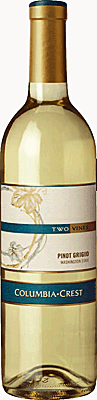
The second white I tried was a much better success and a really great deal. If you’re looking for a cheap summer white wine, perfect for lounging about on the porch in the heat, I strongly suggest buying the 2009 Columbia Crest Two Vines Pinot Grigio. It was on sale at Fred Meyer for $6.99 and comes with the recommendation of earning many “Best Value” awards, but also with an impressive 87 points from Wine Spectator. This Pinot Grigio was much sweeter and less dry than many I’ve had in the past but was so perfectly well-rounded that the sweetness was neither grating nor tiring. It opened with citrus and floral notes and finished with a distinct flavor of honeysuckle. It was extremely smooth, especially for a seven-dollar bottle of wine. I had this wine with fresh tomatoes and basil from the garden, a warm baguette and brie… and as delicious as the food and wine were separately, I’d strongly recommend against the pairing. The food (probably the balsamic vinegar on the tomatoes) made the wine biting and acidic. I’d go for something lighter and less sharp as a pair, perhaps fish or chicken.

To finish, and I know I already posted about this, I entered a wine contest on Snooth.com and would love if you’d read my article here and like, tweet, recommend or plus it! I could win $250 if I beat the other entries.

Any question or comments or wines to try? Email gradsguidetowine@gmail.com.