Monday, February 6, 2012

Ode to Hops


I find myself caught between competing interests when I write this blog and am often hard-pressed to keep the conversation strictly to wine. I drink great beers on a more regular basis than I do wine (you can open beer one without worrying about drinking the rest of the six pack within two days) and find it hard not to write about the latest brew in the fridge. And risking losing my (very) small audience, I’m going to dedicate this blog post to everything-but-wine, get it all out of my system, and return to blogging as normal by the next post.

I think that I mentioned somewhere in the past few posts that I’ve been on an IPA kick of late. Ben and I did not consider ourselves IPA lovers as late as this summer, choosing Ambers, Porters, and Stouts (and even Hefeweizens, uck!) over anything hoppy. Though they weren’t as far down the list as pale ales, we considered IPAs fourth-drink beers – about the point where your taste buds can’t feel or taste a thing. 

 
We visited the Eugene Ninkasi brewery one day with Ben’s friend Carl and tried a sampler of their beers. They were all, save for one, IPAs. Needless to say, I drank a taster of their delicious Oatmeal Stout and steered clear of the rest. The IPAs were ridiculously hoppy and bitter. And then, one day, it just happened that a Deschutes Brewery Inversion IPA tasted delicious. And then a Stone IPA tasted pretty great. And as all taste changes occur, it caused a snowball effect.

I finally came around to Ninkasi, a brewery that makes, in my newly-assessed opinion, the best IPAs. Based out of Eugene, it’s no wonder I’d initially hate the beer and then come to love it. Eugene was for me, initially repulsive – maybe it is the excessively liberal climate, the lack of any kind of downtown area that isn’t a hippie open air market, and the fact that they call Valley River, their small and completely reasonable mall, “Valley Rip-Off” just because you can’t barter for goods there like you can everywhere else in Eugene. And then, slowly but surely, like a good IPA, my fourth-drink-city became beloved. I found little restaurants tucked away that offered amazing happy hour deals on draft beer. I realized that Eugene’s VooDoo Donut is open 24 hours a day and is next to McMenamin’s, where the tater tots are Cajun-ized and often on Happy Hour. I started to like the smell of the market especially when basil was in season, start to enjoy the weird clay wares for sale, begin to love the wet weather because it meant the freshly planted garden was getting much needed rain… 

But I digress. Back to Ninkasi – Ninkasi is crazy success story of a brewery going viral. It opened in June of 2006 with a Total Domination IPA, their best-selling brew to this day. Their tasting room opened in 2009. Ninkasi, named after the goddess of brewing, has become one of the fastest growing craft breweries in the U.S. It consistently receives high marks for its beers. The Total Domination IPA, probably the least hoppy of their IPAs, is still a beer to try once you’ve already decided you like IPAs as it’s still considered an “aggressive IPA.” Once you do love them, don’t hesitate to try it. Total Dom is a gorgeous light orange and wheat color that smells like fresh hops and packs an alcohol content punch at 6.7%. Their second, and my personal favorite IPA, is the Ninkasi Tricerahops, an epic Double IPA (more malt, more hops, and a higher gravity). At about $5.99 a 22oz. (the Total Dom is about $3-4 a 22oz. or $9.99 a six pack), this beer is a luxury in our house. It’s 8.8% alcohol and, speaking from experience, it will damage you if you drink the entire 22oz. If you’re looking to literally double your IPA tastes, then this is the beer to try.
If you’re not seduced by my Ode to Hops, but still want to try an IPA that’s both more reasonably priced and tastes a little less bitter – check out the spring seasonal release of the Alaskan Black IPA. My good friend Maria recently brought this over to my house as an exchange beer for a bottle of homebrew and it was delicious. This IPA, and other black IPAs, combine the malt of a porter or stout with the bright flavor of an IPA. This beer tastes like an IPA on first sip, but quickly turns into a dark and malty finish. Imagine taking a swig of a Deschutes Inversion IPA and following it with their Black Butte Porter (two of my favorite beers). Alaskan calls this beer “sessionable” and I’m inclined to agree. Not an Alaskan Brewing Co. lover, this beer definitely surprised me.

Monday, January 30, 2012

Cotes du Rhone (again)


Three bottles of Côtes du Rhône blends later and it looks like my New Year’s resolution is already shot. Ah well… I suppose that’s what you get for trying to break away from such a delicious group of wines. At least I’m writing about it.

This wine-writing experience for me is not only about drinking wine and writing (two of my greatest loves), but it’s also about learning. I certainly don’t pretend to know everything there is to know about great appellations or terriors. Nor do I know very much about the specific and varied grapes that come from every different region. And my affair with Côtes du Rhône is a perfect example of my naiveté.

I found myself unable to answer my mother the other night when she asked me if a Côtes du Rhône was a type of grape or a region. Though I knew it was a region, I couldn’t figure out what specific varietal it was – probably because I’d never seen anything on the label but "Côtes du Rhône" and the name of the winery from which it came. And so, I started to do a little bit of research. 

Côtes du Rhône (hills or slopes of Rhone) is a controlled appellation in the Rhône wine region of France from which a whole host of delicious blends emerge. Though the Côtes du Rhône, is not, as I may have thought, a varietal – it might as well be, as most wines that come from this region are primarily Grenache and Syrah blends (either red or white from Grenache blanc). To be considered a Côtes du Rhône blend, the wine must have a minimum percentage of Syrah. Though I haven't delved into the white blends, they have similar requirements with a minimum percentage of Grenache blanc required. My favorite Côtes du Rhône, the Reserve Perrin is composed of 60% Grenache, 20% Syrah, and 20% Mourvedre - a relatively common assortment of varietals for a glass of this appellation's wine.

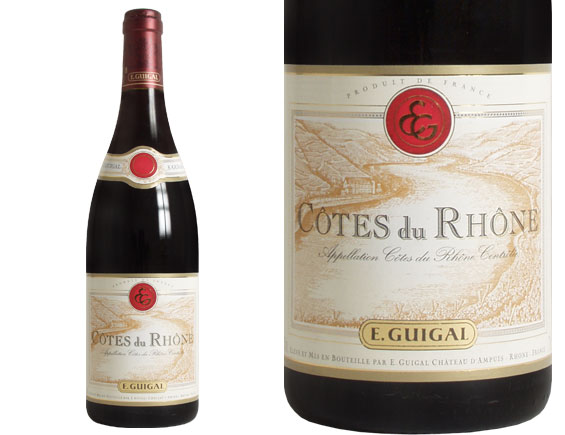
I’ve written about  my favorite blend, the 2009 Perrin Reserve Côtes du Rhône ($10.99), but I haven’t written about two different blends I tried recently. The first, at the recommendation of a Professor of mine, was the 2007 E. Guigal Côtes du Rhône Red ($10.99-12.99). This red, given 90 points by Robert Parker, was delicious, but a bit too Syrah-y for my tastes. I’m not a big fan of the Shiraz/Syrah varietal and as this was about 50% Syrah, it was too much for me. Though the wine was certainly smooth, with a great finish, I thought the cherry and currant led it to be a bit too sour without any tempered soft spices to really balance it out. Though it certainly wasn’t difficult to drink, I found myself, like many other reviewers, wondering why this wine was so revered when less expensive alternatives tasted better.

The second Côtes du Rhône blend I recently tried had a nearly indistinguishable name and label from the 2009 Perrin Reserve Côtes du Rhône. However, the wine was completely different. From the Famille Perrin, the Perrin Reserve Côtes du Rhône Rouge 2010 ($8.99) is a delicious, less expensive alternative to the 2009 Perrin Reserve Cotes du Rhone blend. Though they are nearly identical in name and almost impossible to look up online, the wines were similar in smoothness, spicyness, and both full of rustic Côtes du Rhône flavor. Like the Reserve blend, this wine is also made up of more Grenache than Syrah, lending it a spicy element that countered the sour cherry and currant fruit that was so heavy in the Guigal. We did have to let it sit in the decanter for quite a while, as the sharp tannins at the end were a bit harsh at first and made me feel that the wine was still a bit young. I’d recommend this wine with a lighter meal (or perhaps before the meal entirely), and save the Reserve blend for the heartier pastas and meats.

Friday, January 27, 2012

Chardonnay


I’m a picky person. I don't like very many things. I find the majority of fruits to be a bit too squishy, a small population of vegetables to be horrifying (brussel sprouts, lima beans, peas, cauliflower, etc.), most nuts to be too nutty. I don’t care for most sodas, the majority of tropical-themed juices, and anything MinuteMaid makes my teeth hurt.

And so it constantly surprises me how much I like wine. And how much I like all of the varietals. It's very rare that I'm horrified by a wine, Cupcake Red Velvet, being the most recent exception to the rule. (If it's a sweet red that makes non-wine drinkers go: "Mmm! Tastes like chocolate!" then I probably hate it. And it's probably Cupcake Red Velvet.)

Maybe a year ago, I would have put quite a few varietals in the list of things I didn’t care for – Shiraz, Zinfandel, Chardonnay, Riesling, Pinot Noir. But time and money have conquered most of these dislikes and turned them into loves. I have already chronicled my fear of Pinot Noir and the Oregon summer that lead me to drinking more regularly than a Cabernet or Merlot… But I haven’t spoken about many white wines.

I’ll start with Chardonnay. The Chardonnay obstacle was a mental roadblock - buttery whites that dominate female ordering on 90s television shows spelled out a “No thanks!” for me. The name even sounds terrible. When I say it in my head I imagine a bigger man from a Southern state pronouncing it in an accent, his large hands around a tiny, cheap glass of wine. Maybe it’s the alliteration, or the ugly “Chard” introduction to the word…

But then I had a really cheap, really great encounter with the Columbia Crest Two Vines Chardonnay. I don’t usually make it a habit to buy $6-$7 wines, but one summer day the Wine Spectator’s 89 point rating and the teeny price tag drew me in. You can read more about the tasting experience here.

And then I had another encounter, at over 2x the price of the Columbia Crest that solidified my taste for Chardonnay. I went to a Safeway wine tasting recently (it was every bit as sterile as it sounds, but I’m glad Safeway is trying to offer this!) and they had available a La Crema Chardonnay, Pinot Noir (from the Sonoma coast) and Kendall Jackson’s Summation red. I won’t go into how much I resist buying anything with a name so boring as Kendall Jackson and I’ll admit that I loved the Summation blend (against my aesthetic, creative judgment). I didn’t have high hopes for the Chardonnay, but once again, was surprised.

The 2009 La Crema Chardonnay ($14.99 on sale at Safeway/off sale $20) is a delicious, more adult Chardonnay). Though it was still rich with oak and silky smooth, the wine had a great hint of acidity that cut the smoothness. The dimension in this Chardonnay, blended flavors of honey and apple, complimented by the acidity, pushed it beyond the designation of an easy drinking, summer porch wine Chardonnay. I was blown away by the taste in store and bought it to go with some fresh basil, tomato, and mozzarella pizza. The freshness of all of the flavors reminded me of the crispness of early spring.

If you, like me, fear the large man holding a tiny glass of Chardonnay, pronouncing Merlot “Mer-lot,” or equally fear turning into a mini-skirt clad 90s lawyer ordering Chardonnay at a local bar (I’ve been watching Ally McBeal) – then try the La Crema Chardonnay. I think you’ll take a sip and picture a satisfied oenophile on a terrace somewhere in California, looking over a rolling sea, listening to sea birds.

Sunday, January 22, 2012

Stuck in France

I get stuck in food/taste ruts quite often. I'm not sure what to call it but it's categorized by long bouts of eating the same thing, until I overload my taste buds with the same tastes and swing in a drastically opposite direction. I'm in a yogurt and granola rut right now. Organic blueberry flax granola and greek honey yogurt... I could eat it for every single meal, all day long, for the next two weeks. Last time, it was Pace Medium Picante salsa and Mission Tortilla chips. I ate jars and jars worth of salsa. I can't say it's healthy, but it's taste-bud satisfying and it makes for easy bulk-shopping.

It seems to be the same with alcohol. You can probably chart my wine drinking ruts through this blog. Right now, I'm smack dab in the middle of a Cotes Du Rhone binge. I don't want to drink anything else. And seeing that there are about 2 worthwhile Cotes Du Rhone wines in my price range, there isn't much differentiation in my drinking habits. As for beer, I'm only drinking IPAs. Nothing tastes as rich or as refreshing as a really good, 6%+ IPA. So it's Cotes Du Rhone and a variety of IPAs (Deschutes Inversion IPA and Ninkasi Total Domination IPA, primarily) at our apartment right now and I can't seem to break free. My last alcohol rut was probably Cabernet Sauvignon and Porters... I suppose the difference isn't huge in this case, but I certainly have my patterns.

The weather has been insane here in Washington lately, a big snowstorm (for us) with some nice snow days off of work, an ice storm immediately following, and then big puddles from the snow melt and a bunch of rain. Though the temperatures have been warming up, it's a great time to be drinking rich red wines that serve as fantastic alternatives to turning the heat up all the way to the "Comfort Zone" range. At a dinner party we had last night, a friend brought over a Malbec and Cabernet and Ben, after having a small glass, remarked that he forgot how good a nice glass of red wine can be (the beer drinking seems to have erased his memory) in the chilly weather. I was the designated driver and so I didn't try the Argento Malbec, but everyone around the table seemed to thoroughly enjoy it.

And so the Malbec realization and the wine rut realization merged and I've come up with a resolution (a little late, I know) to drink more variety, beyond the usual big reds I like (into France, Italy, Spain, Germany, Mendoza, South Africa, some more of California and Oregon, and finally into some richer white wine territories). And then I want to pick up writing about it again. I know the blog has fallen off a bit lately with work getting busier and busier and my spare time now filled with using my KitchenAid mixer rather than my Waterford decanter. But, I think it's a ridiculously easy resolution on the scale of self-improvement resolutions.

So off into the wine world 2012 I go. Let me know if you have any pressing recommendations or suggestions on how to break out of ruts - a particularly good varietal would suffice!


Friday, December 16, 2011

Half-priced bottles of wine!


My closest friends and I go out to a fantastic restaurant called Maxwell’s (I know, I’m always writing about it) every Tuesday or Thursday to eat a St. Helen’s BLT with a side of chips or fries, and drink half-priced bottles of wine. We talk about work and friends and what’s on the menu for our next dinner party and generally leave feeling sleepy and full of both food and friends. It is the highlight of my week, to sit under the big sparkling chandelier, a Christmas tree lit up in the window, and drink Merlots or Cabernets from their restaurant Riedels. 

There is something ridiculously fun about ordering a bottle of wine at the table. We get to scan a long wine list, and without labels and without any guidance but tastes in varietal, we pick a bottle that could be completely awful (but never is)… and then, the tasting. I love how the waitress pulls out the cork and places it, wine side up on the table, the deep purple soaked through the cork, covering the vintner’s monogram or little design, and then pours you a tiny sip. I always feel a tiny bit silly swirling my wine around, breathing in the nose, and then tasting that almost warm, always juicy first sip of wine. 

And then wine is poured around the table, swirling through each glass, catching the light, and everyone tastes and comments and usually sighs with post-work-first-glass-of-wine happiness. I don’t know if it’s the community feel this whole ritual, or the fact that it’s a time-honored process that we just inherently know how to do, but I always feel older and wiser and more stable when I’m sitting at the table ordering a bottle of wine.


A couple of weeks ago we ordered an 2009 Owen Roe Sharecropper’s Cabernet Sauvignon  from the Columbia Valley. It was $42 at the restaurant, and then half price, bringing it down to just a bit above the store price ($15 retail) – which is a steal, if you ever buy wine out! The wine was in a squat bottle with a rustic label of a horse pulling a cart and I felt like we should have been in a barn drinking wine on straw bales. The wine was just as lush as the farm notion – full of ripe berries like plum and cherry. The finish was lush with structure and some noticeable tannins. It was a great warm, lush winter wine.


Last night, we went to Maxwell’s and again ordered a bottle – but this time, we tried a Merlot. My friend Whitney, who is also getting into wine, had forwarded me an article about Merlot coming back (after its Sideways-inspired, Yellow Tail-enforced, downfall). I have always been a Merlot fan, but after discovering Cotes-Du-Rhone recently, I hadn’t the heart to drink anything that wasn’t perfectly complex and rustic like the Reserve Perrin Cotes. Luckily, we ended up with a delicious bottle of a Balboa Vineyards 2009 Mirage Vineyard Merlot. It was originally $32 at Maxwell’s and half off, cheaper than the in-store cost ($22 retail). The Merlot was very well balanced, with a fruity bouquet, complimented by some acidity at the end of the sip and a bit of spice to finish the sip. The Merlot was certainly as complex and as enjoyable as the Cabernet, regardless of what silly wine movies say!

I suppose the moral of the story is that good friends, good food, and good restaurants are made even better by good, cheap bottles of wine. I suggest you keep your eye out for a half-priced bottle of wine restaurant and start working your way through an unknown, and unfamiliar, wine list!